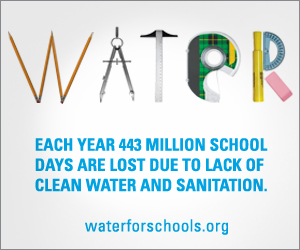
Last week was Blog Action Day, a day where 4,319 Blogs and 33.2 million readers from 131 different countries came together virtually to highlight and read about clean water.
In all honesty, most of us probably don’t care very much about the water crisis in Africa. It’s not something that affects us on a daily basis. Like the Millennium Development Goals, world peace and climate change, the scale and enormity of water issues is larger than what any one person can change.
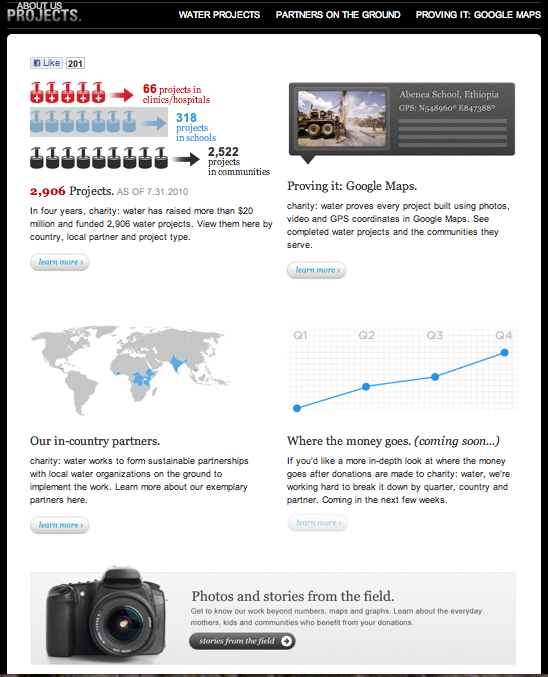
On this blog, I explore ways that people successfully communicate and personalize complex issues. I’d like to highlight charity : water, a nonprofit organization that helps to bring clean water to people in developing nations. Charity : water does an amazing job of leveraging social media and visualization to personalize the complexities of the water crisis. Their site provides easy, actionable tools to engage the public.
Whether you care about water or not, any individual, organization or company could benefit from learning about charity : water’s branding and marketing strategies.
If you are attending the Justmeans Social Media, Techonolgy, and Change Conference November 1st, you’re in luck- COO Ron Arnold will be speaking. Tickets are going fast- be sure not to miss out on the opportunity to hear from social innovators like Arnold by clicking here!
What I like about their approach:
We’ll continue to show you what the global need for clean water really looks like. Not through statistics or numbers, but through individual lives. Armed with cameras and GPS devices, we send photographers into the field to document the projects you help fund.
Some information about from Charity : Water about the link between food and water:
Crash games represent one of the more transparent categories in online gambling, and JetX sits at the centre of that conversation for many Australian players. Unlike slot machines, which rely on opaque reel algorithms, or table games with fixed house edges baked into centuries of tradition, JetX operates on a publicly visible multiplier curve that rises until it doesn’t. That simplicity is deceptive. Underneath the animated jet climbing across the screen is a provably fair random number generation system, a real-time cashout mechanic, and a set of probability distributions that reward players who understand what they’re actually wagering on. This breakdown is aimed at players who want to move past surface-level familiarity and understand the structural logic of how the game functions.
Every round of JetX begins with a server-side seed that determines when the multiplier will crash. The game uses a provably fair algorithm, a cryptographic method popularised in online gambling around 2014 when Bustabit introduced it to the crash genre. In this system, the crash point is calculated before the round begins, and the seed can be verified by players after the fact to confirm the outcome wasn’t manipulated. SmartSoft Gaming, the developer behind JetX, implemented this architecture when the game launched in 2019, and it remains the core integrity mechanism of the product.
The multiplier itself starts at 1.00x and increases continuously from the moment the round begins. The rate of increase is not linear — it accelerates as it climbs, which is why reaching 10x feels faster than reaching 2x once you’ve watched enough rounds. The crash point can theoretically occur at any value above 1.00x, including immediately. Statistically, rounds that crash below 1.50x occur with meaningful frequency. According to SmartSoft’s published return-to-player data, JetX carries a theoretical RTP of approximately 97%, which is relatively high for a casino product, but that figure is distributed across all possible multipliers, including the catastrophic early crashes that wipe bets entirely.
The house edge is embedded in the crash distribution itself. If the game were perfectly fair, the expected value of holding until crash would be 1.00x on average. The 3% house edge means the expected value of any given bet, held to crash, is approximately 0.97x. This is structurally identical to a roulette wheel’s edge — it doesn’t mean you lose every time, but it means the distribution is tilted against the player over a sufficient number of rounds.
The cashout button is the only active decision a player makes in JetX, and it’s the mechanism that distinguishes the game from passive slots. Players place their bet before the round begins, then choose when to cash out during the multiplier’s ascent. Cashing out at 2.00x doubles the bet; cashing out at 5.00x returns five times the stake. If the jet crashes before the player cashes out, the entire bet is lost.
Most platforms that host JetX, including Casinozoid, offer an auto-cashout feature that allows players to set a target multiplier in advance. This removes the emotional variable from the decision — a significant factor, because the visual design of the climbing jet creates genuine tension that affects real-time decision-making. Research into gambling psychology has consistently shown that players under time pressure tend to hold longer than their stated strategy, a phenomenon sometimes called “crash chasing.” Auto-cashout doesn’t eliminate variance, but it enforces discipline that manual play rarely sustains over long sessions.
Players researching strategy before committing real money will often find resources that detail the probability mathematics involved. For example, understanding how to play JetX at a mechanical level — including how the auto-cashout interacts with round timing and how simultaneous bets work — is foundational before applying any multiplier targeting strategy. The dual-bet feature, which allows players to place two separate bets per round with different cashout targets, adds a layer of strategic complexity that casual players frequently overlook.
Australian players occupy a specific legal position when accessing JetX. The Interactive Gambling Act 2001, amended most significantly in 2017, prohibits Australian-licensed operators from offering most forms of interactive gambling to Australian residents. However, the legislation targets operators, not players, meaning Australian residents are not committing an offence by accessing offshore platforms that host JetX. The practical consequence is that most players access the game through international operators licensed in jurisdictions such as Malta (MGA), Curaçao, or Gibraltar.
This regulatory gap creates a consumer protection consideration that’s worth understanding. Operators licensed under the Malta Gaming Authority, for instance, are subject to responsible gambling requirements, dispute resolution frameworks, and technical standards that cover RNG certification. Curaçao-licensed operators face lighter regulatory oversight, which means the protections available to players vary significantly depending on which platform they use. Casinozoid, which covers JetX among its featured titles, operates under licensing that subjects it to external audit requirements for game fairness — a relevant detail when the entire integrity of a crash game rests on its RNG implementation.
The Australian Communications and Media Authority maintains a list of illegal gambling services and has issued notices to a number of offshore operators since 2017. Players should verify that any platform they use has not received an ACMA blocking notice, as several have over the years. This doesn’t make the game itself less legitimate — SmartSoft Gaming’s JetX is certified and distributed through licensed channels globally — but it does affect which access points are considered compliant with Australian regulatory expectations.
JetX is a high-variance product despite its seemingly simple structure. The distribution of crash points means that long sequences of low multipliers are statistically normal, not anomalous. A run of ten consecutive crashes below 2.00x is uncomfortable but falls well within expected probability bands. Players who respond to such sequences by increasing bet sizes to recover losses are engaging in a pattern that the game’s variance profile punishes systematically. The expected value of any individual round doesn’t change based on what happened in previous rounds — the provably fair RNG has no memory.
Session bankroll management in JetX requires thinking in units rather than absolute amounts. A standard approach among experienced crash game players is to define a session bankroll, set a maximum bet as a percentage of that bankroll (commonly 1-5%), and apply consistent cashout targets rather than adjusting them based on recent outcomes. At a 2.00x cashout target, a player needs to cash out successfully more than 50% of the time to maintain positive expected outcomes against the house edge — specifically, they need a success rate above approximately 51.5% to break even before variance. At higher cashout targets, the required success rate drops, but the probability of any individual round reaching that multiplier also drops proportionally.
Casinozoid’s coverage of JetX includes round history displays and statistical overlays that show recent crash distribution data. These tools are useful for orientation but shouldn’t be interpreted as predictive. A crash history showing twenty consecutive rounds above 3.00x doesn’t increase the probability of the next round crashing low — it’s simply the observed sample of a random process. Understanding this distinction is the difference between informed play and pattern-seeking behaviour that the game’s architecture doesn’t support.
JetX rewards players who approach it as a probability exercise rather than a momentum game. The mechanics are genuinely transparent by casino standards — the provably fair system, the published RTP, and the visible multiplier curve all give players more information than most gambling products offer. That transparency doesn’t change the fundamental mathematics, but it does mean that players who invest time in understanding the structure are making decisions based on real data rather than intuition. For Australian players navigating an offshore-dominated landscape, combining that mechanical understanding with careful platform selection is the most practical foundation for engaging with the game responsibly.
food supply.
Feeding our world takes up to 90% of our freshwater withdrawals but many people in developing nations still don’t have access to enough water for irrigation. When a water project is built in a community, members can often use the new water source to grow small gardens near their homes and secure their own food supply. Self-sufficient households are less affected by external conflict, famine or inadequate government services.
Right now, almost a billion people on the planet don’t have access to clean, safe drinking water. That’s one in eight of us.
charity: water is a non-profit organization bringing clean, safe drinking water to people in developing nations. We use 100% of public donations to directly fund sustainable water solutions in areas of greatest need. Just $20 can give one person clean water for 20 years.